Why Meeting Minutes Read Differently from a News Report
Why meeting minutes read differently from a news report: learn to locate a decision in the record without mistaking brief notes for the full debate.
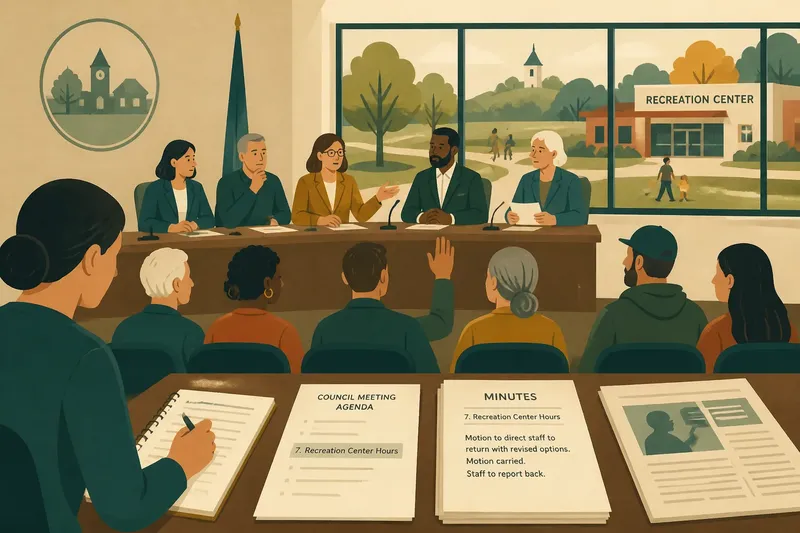
The most common mistake with meeting minutes is reading them as a shortened news report. That can make a routine motion look like the whole story—or make a significant decision seem to have arrived without debate. Why meeting minutes read differently from a news report comes down to purpose: minutes preserve an official record of proceedings, while a report explains what happened and why it matters.
Imagine that, in a clearly invented town called Bellwether, the council considers a proposal to change the hours at a neighborhood recreation center. The published minutes give the item a few lines. A local reporter’s story describes residents’ concerns, the council’s discussion and the practical consequences. Both accounts can be accurate, yet they answer different questions.
Start with the record’s job, not its length
Bellwether’s minutes are written for someone who may need to establish what the council formally did. They might record the meeting date, members present, the name of the item, the motion, a vote and any resulting direction to staff. They are not necessarily intended to capture every argument, reaction or exchange.
A news report is built around a different task. It selects the consequential parts of the meeting and gives them context: what prompted the proposal, who stands to be affected, what alternatives were considered and what happens next. It may quote people or explain a disagreement that the minutes compress into a procedural note.
This difference matters when a brief entry says, for instance, “Motion to adopt revised center hours; motion carried.” The line establishes an action and its outcome, assuming the minutes are approved and the vote is recorded correctly. On its own, it does not explain why the hours changed, whether there were objections or how implementation will work.
Minutes can be terse without being defective. Their value is not measured by how much of the conversation they reproduce. A reader should ask what the record is meant to establish before judging what its silence means.
Follow the agenda item to the formal action
In the invented Bellwether case, the first useful task is to find the exact agenda item. Search the council’s meeting packet or minutes for “recreation center hours,” then note the item number or heading. That gives you a stable reference when related documents use slightly different wording.
Next, read the entry for the action itself. Look for verbs such as “moved,” “adopted,” “referred,” “tabled” or “directed.” These words describe different procedural outcomes. “Referred” may send a matter to a committee; “tabled” may postpone consideration; “adopted” records approval of a motion. Do not treat them as interchangeable signs that a proposal is finished.
Then check what the motion actually covered. A motion might approve new hours, ask staff to prepare a revised schedule, or authorize a trial arrangement. The subject heading may be broad, while the operative wording is narrow. If the minutes summarize rather than reproduce the motion, look for an attached resolution or other document identified in the record.
In the hypothetical Bellwether meeting, suppose the minutes say the council “directed staff to return with revised options.” That is not the same as adopting new hours. The observable result to expect is a later staff report or agenda item, not an immediate schedule change. The wording marks the difference between a request for further work and a final decision.
Read votes and follow-up as separate clues
A vote entry helps establish whether a motion passed, but it may not explain how individual members reasoned. If the minutes list names beside “ayes” and “nays,” that records the vote distribution. If they simply say “carried,” the record may provide less detail. Neither format, by itself, tells you what each member said before voting.
Check for abstentions, absences and recusal notes where they appear. These can help explain why the names or tally do not match what a reader expected. They are procedural facts, not a substitute for the discussion. Avoid turning a recorded vote into a claim about a member’s motive unless another reliable source supports it.
Follow-up language can be just as informative as the vote. Phrases such as “staff to report back,” “refer to the parks committee” or “return at a future meeting” point toward the next place the issue may appear. In Bellwether, a direction to draft options would leave the central choice open. A later meeting could consider those options and make a separate decision.
For a quick reading, mark three things: the motion, its outcome and any assigned next action. That small note prevents a common leap—from “the council discussed it” to “the council decided it”—and helps you search later records without having to reread the entire packet.
Why meeting minutes leave questions open?
Do meeting minutes include everything people said?
Usually, minutes are a record of proceedings rather than a transcript, so they may summarize discussion or omit individual remarks. Check whether the local body also publishes audio, video or a separate transcript if you need the fuller exchange.
Can a short entry establish that a decision was made?
It can establish a formal action when it records a motion and its outcome clearly. Read the motion’s scope and any linked resolution before deciding exactly what was authorized.
What if the minutes do not explain why a vote happened?
That gap does not prove there was no reason or discussion. Consult available recordings, staff materials, written comments or later reporting, and keep clear which source supports each part of your account.
Are draft minutes the same as approved minutes?
Not necessarily: a draft may still be subject to correction or approval by the body. Look for a label or approval notation, and distinguish a preliminary record from the version formally adopted.
Use other records to restore context, not to rewrite the minutes
When Bellwether’s short entry leaves the debate unclear, the next move is to seek material that answers the missing question. A meeting recording may capture the exchange. A staff memo may explain the options presented. Written public comments can show what residents asked the council to consider. A later agenda may reveal whether the matter returned.
These sources do different jobs. A staff memo describes the administration’s analysis or recommendation; it does not establish what the council ultimately decided. A recording can reveal what was said, but the formal minutes remain the concise record of the body’s proceedings. A news report can connect those pieces, but it should not be mistaken for the official action itself.
Say you are writing a note for a neighbor who wants to know whether center hours have changed. In this invented situation, the minutes say staff must bring back options, and a recording captures members debating evening access. The responsible answer is that the council discussed the issue and requested more work; the record does not yet show a change in hours. That distinction is useful even before the next meeting supplies an outcome.
It is not worth the effort to treat every missing sentence as a mystery or to hunt through unrelated documents for a hidden explanation. Start with the item and the action. Add another source only when it answers a specific open question, such as what alternatives were discussed or when staff must report back.
Make a careful account of what the record says
A reliable reading separates three levels of information: what the minutes directly record, what another source adds, and what remains unknown. For Bellwether, “staff was directed to return with options” belongs in the first category. A recording of residents urging later hours belongs in the second. Whether the council will eventually approve those hours belongs in the third.
Keep the verbs precise. “Discussed” describes consideration; “directed” describes an assignment; “approved” describes an action only when the record supports that wording. If the minutes are brief, say that they record a motion and result, not that they recount the full meeting. This makes a short account more useful, not less.
When checking why meeting minutes read differently from a news report, begin with the action, trace any follow-up, then consult another source for the context the minutes were not designed to carry. The practical benefit is a cleaner account of what officials decided—and a clear boundary around what the record cannot tell you.