A Reading Routine for Following One Local Story
A reading routine for following one local story helps you spot what changed, keep useful context, and choose what to check next without rereading everything.
The common mistake in following a local story is rereading every update from the beginning. It costs attention and makes a small change—a revised bus route, a new meeting date—hard to distinguish from background. A reading routine for following one local story works better when each return has a clear purpose: identify what the new item adds and decide what deserves your attention next.
Choose a thread, not a complete archive
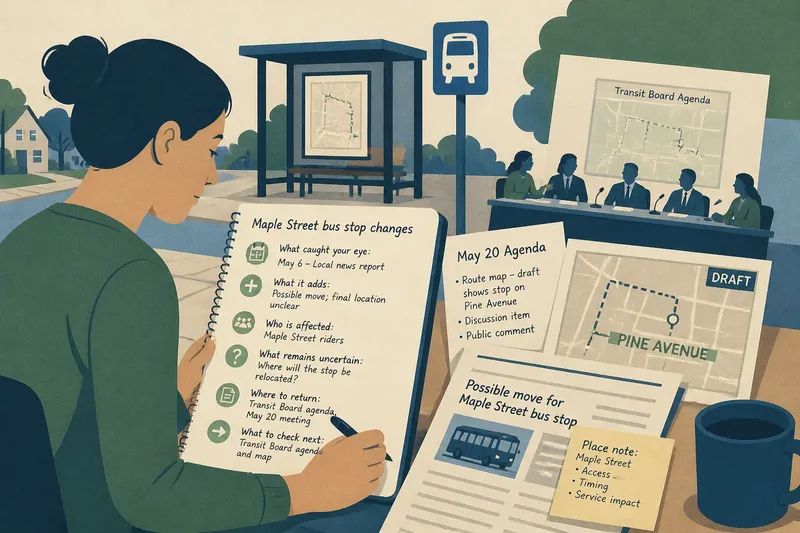
Open a note in a tool you already use: Apple Notes, Google Keep, a text file, or a paper notebook. Give it a title that names the place and subject, such as “Maple Street bus stop changes.” Keep the note focused on the questions a resident might actually have: what is changing, who is affected, and where the next useful update may appear.
Instead of collecting every link, keep a compact entry for each meaningful return:
- What caught your eye: Record the new item’s date and a few identifying words. If the date is unclear, note that rather than guessing.
- What it adds: State the specific new detail, such as a route map or a meeting agenda. If it repeats earlier background, mark it as context and move on.
- Who is affected: Note the neighborhood, service, or group named. If the item does not say, leave the impact unresolved rather than filling the gap yourself.
- What remains uncertain: Write one question that could change your understanding. If nothing material is unclear, record that and stop searching for a question.
- Where to return: Save the strongest pointer, such as a document title and meeting date. If the source is a webpage likely to change, save the link too; otherwise, its name and date may be enough.
- What to check next: Name a likely event or source, such as a transit-board agenda. If no next event is identified, wait for a relevant notice instead of checking every day.
This is a reading aid, not a second newsroom archive. Skip details that do not affect the local question you are following.
Follow the neighborhood question behind the headline
Local stories often matter because a decision touches a familiar place: a school boundary, a bus stop, a park entrance, or a library branch. Keep a short “place note” alongside the update. Name the street, institution, or area, then note what residents may need to understand about it, such as access, timing, or a service that could change.
Be careful not to turn a possible effect into a confirmed one. If a draft map appears to move a bus stop, write that the draft shows a proposed move. If an official notice says the stop has moved, record the change as completed. The wording should match the source and the stage of the story.
Say you are following a proposed change to the Maple Street bus stop. Your starting information is a local news report that describes a possible move but does not give a final location. You add the report’s date, write “possible move; final location unclear,” and note that the transit board’s next agenda may address it. Later, an agenda includes a map showing the stop on Pine Avenue, but calls the map a draft. You add the map’s title and meeting date, preserve “draft” in your note, and leave the outcome open. The resulting record tells you that a location has been proposed, not that riders must already use it.
Make each source useful for a particular question
A local news story may connect several voices and explain the broader dispute. A public notice can point to a hearing or comment period. A meeting agenda may show what officials plan to discuss, while minutes or a recorded vote can help establish what happened. A resident’s account can describe an effect that an official document does not capture.
Choose sources according to the question in front of you. If you need to know when a meeting is scheduled, look for the notice or agenda. If you want to know what a particular household experienced, look for a clearly attributed account. If you need to distinguish a planned discussion from a completed action, return to the meeting record or the institution’s later notice.
When saving a document, make the pointer easy to use: include its title and the relevant page, section, or meeting date. When a source is a person’s statement, note who spoke and where the statement appeared. That small detail helps you return to the original context rather than relying on a paraphrase that has drifted.
What deserves your attention on the next visit?
How do I tell a fresh development from background?
Compare the item with your last note and look for a new action, document, date, map, or account. If it only retells the earlier history, mark it as background and do not add it as a change.
What should I do when sources disagree?
Write down the two claims, who made each, and the precise point they differ on. If neither source resolves it, keep the disagreement open and look for a document or statement that addresses that specific point.
When should I return to the story?
Use a named event, such as a scheduled hearing or a promised notice, as your cue. If there is no date, check when the relevant institution posts new material or a reliable local report identifies a development.
What if I find no new information?
Note the date and the relevant source you checked, then write “no new development found.” If the next expected event has not occurred, wait for it rather than repeating the same search.
Keep the routine light enough to repeat
On each visit, read the new item, add only the details that change your understanding, and choose one sensible next check. If a major event happens, add what it changes and what remains open. You do not need to reconstruct the full history every time.
Copying entire stories, saving every social post, and refining notes until they sound polished are not worth the effort. They create a larger archive without necessarily making the local question clearer. Keep only enough context to recognize the place, follow the change, and return to a useful source.
A reading routine for following one local story is most useful when it keeps the human question in view: what might change for this place, and what would make that change clear? A concise note can preserve the difference between a map on the agenda and a route riders are expected to use, while giving you a practical reason to return when the next relevant record appears.