Agenda or Background Paper: Which Meeting Document Should You Read First?
Choose the right local meeting document first: use the agenda to locate decisions, or the background paper to understand the reasoning and context.
The common mistake with a local meeting topic is opening the longest document first. A background paper may explain the issue in detail, but if you need to know what officials will consider or decide, the agenda is usually the better starting point. Choosing between an agenda and a background paper depends on the question you brought to the record.
Start with the question you need answered
Before opening either file, put your question into a sentence. Are you trying to find when a topic will be discussed, identify the action proposed, understand why staff recommend it, or see what options were considered? Each question points to a different document.
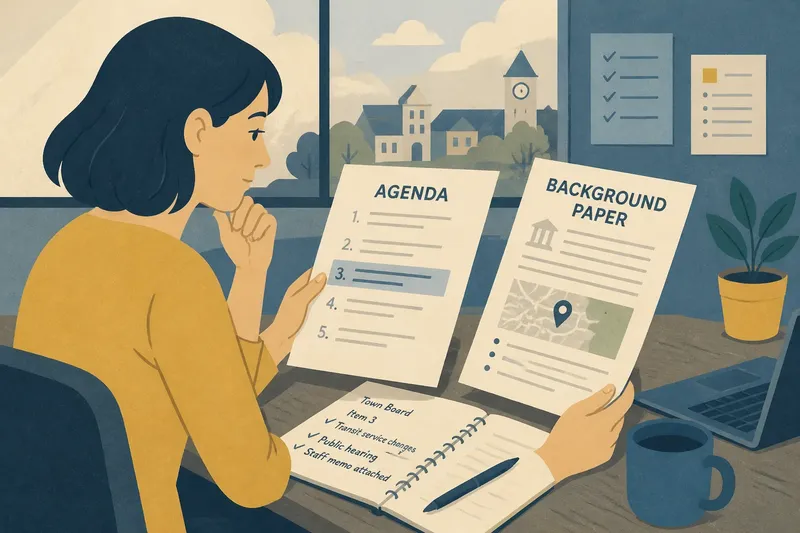
An agenda is the meeting’s organized map. It groups topics into items, gives their order and may name the action requested. A background paper—also called a staff report, briefing note, or memorandum in some local governments—usually supplies context for one of those items. It may describe the issue, outline alternatives, explain a recommendation, or attach supporting material.
Names and formats vary. A small board may publish a short agenda with linked documents; a county council may attach a lengthy staff report to a numbered item. Look for the document’s purpose and links, not just its filename.
Read the agenda first when you need the meeting’s shape
Open the agenda when you need to locate a topic, understand where it sits among other business, or identify what the body is being asked to do. Scan the meeting date, body name, item headings, and any action language such as “consider,” “authorize,” or “receive.” Those words can help distinguish a discussion from a request for formal action, though the surrounding record matters too.
Note the item number and any linked attachments. An agenda may list a proposed contract under a brief heading while linking to a separate report with the reasoning. The agenda tells you where to look; it rarely answers every question about why the item is there.
Say you want to know whether a town board is considering a new bus stop near a library. The agenda lists “transit service changes” under a public hearing and links to a staff memorandum. The agenda is the useful first read for locating the item and seeing its place in the meeting; the memorandum is the next stop for the proposed location and the reasons behind it.
Turn to the background paper when you need the reasoning
Once you have the relevant agenda item, open its attachments. Start with the main background paper rather than every linked file. Look for the problem being addressed, the options described, the recommendation, and the action requested. These sections may explain what information staff relied on and what trade-offs they considered.
Check whether the paper distinguishes existing conditions from proposals. A sentence describing a current service is not the same as a recommendation to change it. Likewise, an option discussed in the report is not necessarily the option officials will choose. Keep the agenda’s action wording beside the paper’s recommendation so you can see how the documents relate.
Attachments can add detail, but not all are equally useful for every question. A map may clarify a proposed location; a draft policy may show the wording under consideration; a technical appendix may support a narrow claim. Follow the link that answers your question rather than treating every attachment as required reading.
Use both documents without confusing their jobs
For a quick account of what is scheduled, read the agenda and stop when it answers your question. For the rationale behind a proposal, read the background paper after locating the matching item. If you need both the decision under consideration and its context, move between them: use the agenda to confirm the item and requested action, then the paper to inspect the explanation.
When the documents appear to differ, first check that they concern the same meeting and item. An agenda can be revised, and an attachment may have a separate title or date. Compare the exact item number and wording before assuming a contradiction. If the available copy does not make the relationship clear, a clerk or records contact can point you to the current file.
What is not worth the effort? Reading a long report from its first page when your immediate question is simply whether the topic appears on the meeting schedule. A quick agenda scan can save you from digging through background that does not address your need.
Which document answers your question?
Where do I find the order of business?
Start with the agenda. It shows how meeting items are arranged and may indicate when the topic is scheduled, though the order can change during a meeting.
Where can I find the reason for a recommendation?
Read the background paper linked to the agenda item. Look for the stated problem, options, supporting details, and recommendation rather than relying on a short agenda heading.
Does an agenda item mean a decision will be made?
Not necessarily. The item may be for discussion, a hearing, or formal action; examine its wording and the linked paper to understand what is requested.
What if the background paper is missing?
Use the agenda to identify the item and note any references to attachments or staff reports. Check the local body’s records page or contact its clerk to ask whether a related paper is available.
Make a short reading note for yourself
After reading, record the meeting body, item number, document title, and the specific answer you found. Separate what the agenda says from what the background paper explains. That small distinction keeps a schedule, a recommendation, and a decision from collapsing into one vague impression.
For the search phrase “agenda or background paper,” the practical rule is simple: choose the agenda to find the meeting’s structure and requested action; choose the background paper to understand the issue and reasoning. When a story requires both, begin with the agenda, then follow its item into the paper. You will arrive at the relevant context without mistaking the map for the explanation.